Architecture
A runtime that separates product code from platform concerns.
Democr.ai is organized around a core runtime, renderer clients, installable extensions, and configurable infrastructure. The same application can run local-first or coordinate work across a cluster.
Core shape
One core, multiple clients, explicit extension points.
The core coordinates application behavior. Clients render. Extensions add product, model, and ingestion capabilities through public contracts.
SDK boundary
Sandbox
RBAC
Quotas
Correlation ids
Runtime core
Owns routing, module loading, auth context, storage providers, task orchestration, media access, and observable execution flows.
SDK boundary
Exposes the public surface used by modules, engines, and extractors. Extension code should not import private core internals.
Renderer clients
Web, desktop, and mobile-oriented clients render A2UI payloads and apply effects. They do not own business logic.
Engine orchestration
The same runtime supports a local orchestrator or a node-aware cluster.
Single-node deployments can invoke the engine orchestrator directly. Cluster deployments can put engine jobs in a shared queue, publish node state, and stream responses through Redis-backed channels.
Single node
Runtimemodel or objective request
gRPClocal orchestrator
Engine workerwarm model handle
Cluster
Queueshared invocation row
Placementcapability, warm model, resources
Nodeclaim, run, stream response
Node state
Runtime nodes publish heartbeat, CPU/RAM/VRAM availability, and warm engine instances.
Placement scoring
Jobs prefer nodes that can satisfy the requested model or capability, with affinity for warm local instances.
Response streams
Cluster mode can use Redis-backed response streams so callers receive output even when work lands on another node.
Request flow
A client action stays small because the runtime carries context.
User, organization, module, thread, media, model, and stream context move through the runtime instead of being rebuilt in feature code.
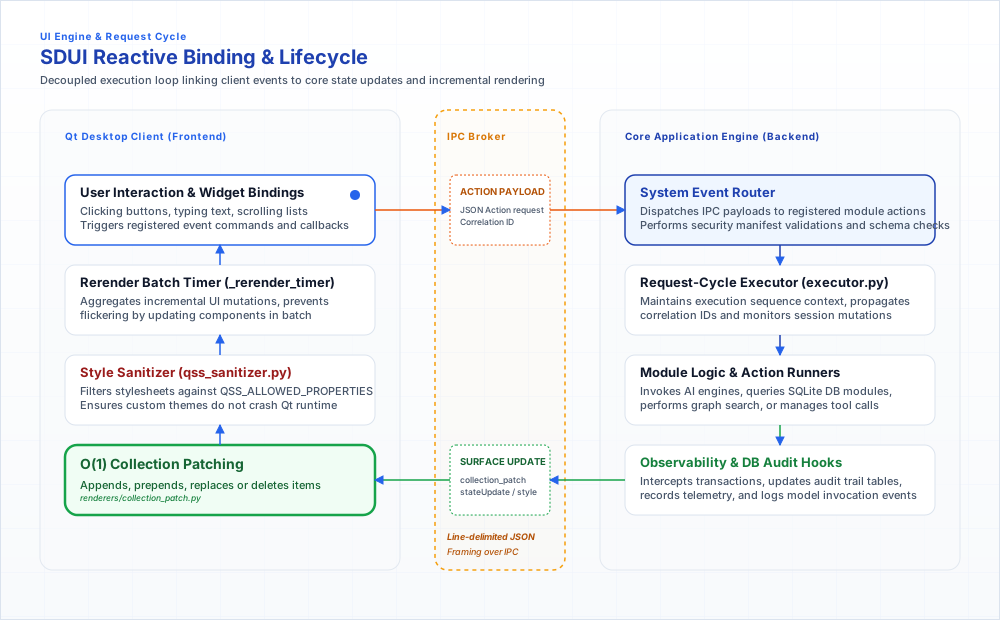
Client eventA UI action sends a payload through IPC or WebSocket.
DispatcherThe core resolves route, module, permissions, and request context.
ActionThe module runs product logic through SDK methods only.
ProviderConfigured services handle storage, media, AI, knowledge, or tasks.
StreamActions can publish incremental UI effects before the final response.
RendererClients apply A2UI updates without owning domain behavior.
Deployment axis
Local-first does not mean local-only.
The same runtime shape can start with local providers and move services outward when deployment needs shared infrastructure.
Main runtime
Routing, auth context, module actions, SDK domains, media access, and UI effects.
Engine workers
Model loading and inference stay out of UI-critical paths and can be warmed up separately.
Knowledge workers
Extraction, ingestion, embeddings, graph enrichment, and query service work asynchronously.
Local providers
SQLite, local media, sqlite-vec, and local graph/vector providers support development and desktop use.
External services
Configuration can move storage, queues, graph, vector, media, and observability providers out of process.
Worker model
Engines and background services can run outside the UI process so model loading and ingestion do not block rendering.
Runtime ownership
Each layer owns the part it can keep coherent.
This is the main design constraint: avoid pushing platform concerns into feature modules or renderer clients.
| Layer | Owns | Does not own |
|---|---|---|
| Modules | Product behavior, routes, actions, YAML UI, models, tools, agents, skills, locales. | Storage providers, client renderers, engine internals, global runtime policy. |
| Core | Dispatch, identity context, permissions, module loading, provider resolution, tasks, streams. | Feature-specific product behavior or provider-specific model logic. |
| Providers | Database, media, vector, graph, observability, model execution, extraction implementation. | Module UI decisions or cross-feature orchestration policy. |
| Clients | A2UI rendering, local interaction handling, effect application, visual feedback. | Business rules, persistence rules, permission checks, model/provider selection. |
Modules own product behavior
A module defines routes, models, actions, YAML UI, tools, agents, skills, assets, and locales for one feature area.
Core owns coordination
The core resolves providers, applies context, dispatches actions, manages tasks, and exposes observability.
Providers own capability implementation
Engines and extractors implement specific runtime methods while keeping application code provider-independent.
Next
Related pages
Use these pages to move from the concept to adjacent parts of the runtime.