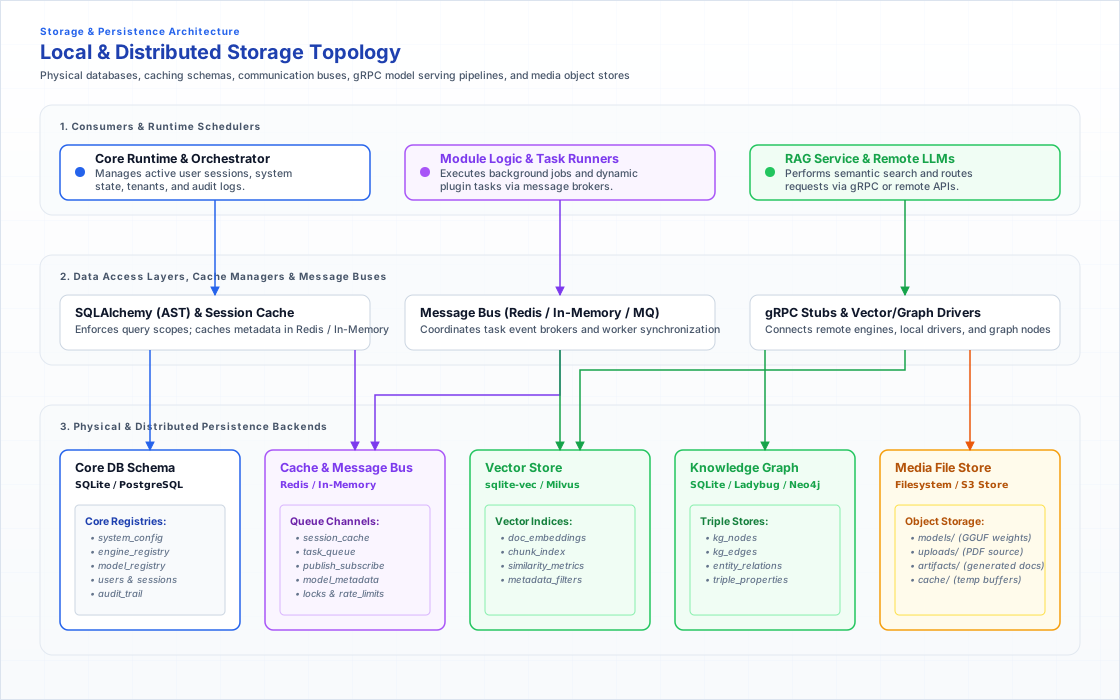
Storage and media
Relational data can use local or shared database providers. Media can stay on disk locally or move to object storage with a public delivery endpoint.
Configuration
Democr.ai lets deployments choose storage, media, AI, extraction, vector, graph, and observability providers while modules keep using the same SDK contracts.
Provider map
Modules should not hardcode infrastructure choices. They ask the SDK for capabilities, while deployment config selects storage, media, knowledge, engine, and observability providers.
Relational data can use local or shared database providers. Media can stay on disk locally or move to object storage with a public delivery endpoint.
Models are configured with capabilities, runtime methods, provider options, and performance defaults. Application code asks for objectives or explicitly configured models.
Extractor, embedding, vector, and graph providers define whether a deployment can ingest files, search chunks, or retrieve graph context.
config.yaml examples
These snippets are intentionally partial. They use keys from the project configuration examples and show where local and distributed deployments usually differ.
database:
  type: sqlite
  data_type: sqlite

storage:
  media:
    type: local
    path: /home/user/.local/share/democrai/assets
  kg:
    type: ladybug
  vector:
    type: sqlite-vec
  observability:
    type: sqlite

network:
  redis:
    enabled: false

session:
  identity:
    provider: sqlite
  ui_state:
    provider: sqlite
  cache:
provider: memorydatabase:
type: postgres
url: postgresql://democrai:secret@localhost:5432/democrai_core
data_type: postgres
data_url: postgresql://democrai:secret@localhost:5432/democrai_data
storage:
kg:
type: neo4j
uri: bolt://localhost:7687
user: neo4j
password: secret
vector:
type: milvus
host: localhost
port: 19530
network:
redis:
enabled: true
url: redis://localhost:6379/0
session:
identity:
provider: redis
ui_state:
provider: postgres
url: postgresql://democrai:secret@localhost:5432/democrai_ui_state
cache:
provider: redisknowledge:
vector_index:
tenant_id: democrai
app_id: knowledge
name: items
metric: cosine
retrieval:
graph_traversal_depth_default: 3
graph_expansion_limit: 12
graph_score_weight: 0.25
runtime:
poll_interval_seconds: 1.0
batch_size: 32
lease_seconds: 60
max_attempts: 12Knowledge enablement, embedding/rerank/classification/triple-extractor model selection, and MIME-to-extractor bindings are runtime settings stored in the database and managed from the system UI.
knowledge:
  query_service:
    enabled: true
    # unix on Linux/macOS, tcp on Windows when omitted.
    # transport: unix
    # socket_path: /home/user/.local/state/democrai/knowledge-query.sock
    host: 127.0.0.1
    port: 50153
    startup_timeout_seconds: 30
    timeout_seconds: 120
    max_message_mb: 64

ai:
  engine_orchestrator:
    enabled: true
    transport: tcp
    host: 127.0.0.1
    port: 50151
    startup_timeout_seconds: 30
    invoke_timeout_seconds: 0
    max_message_mb: 128
    scheduler_worker_count: 4
    batch_wait_seconds: 0.05
    runtime_transition_worker_count: 1
    invocation_worker_count: 4
    tls:
      enabled: false
      cert_file: ""
      key_file: ""
      ca_file: ""

engines:
  # extra_paths:
  #   - /srv/democrai/external-engines

extractors:
  # extra_paths:
  #   - /srv/democrai/external-extractors
If the engine orchestrator uses TCP on 0.0.0.0 or on a non-loopback host, TLS is required. Service JWT authentication remains enabled for orchestrator RPCs.
Local to distributed
A local setup can use SQLite, local media, sqlite-vec, and local graph providers. A distributed setup can move those concerns to Postgres-compatible storage, object storage, Redis-backed coordination, Milvus, Neo4j, ClickHouse, or other configured providers. Provider implementations may appear before they are certified through the current integration pass.
Responsibility split
The boundary is useful because it keeps feature modules portable across development, desktop, server, and distributed deployments.
Modules consume SDK capabilities such as UI effects, scoped models, media, AI, tasks, and knowledge.
The core resolves configured providers and carries user, organization, module, request, and runtime context.
Providers implement the actual storage, model, extraction, graph, vector, and observability behavior.