SDK access
Modules call SDK methods for database, media, UI, tasks, AI, and knowledge rather than importing private runtime code.
Security
The runtime is designed so modules, engines, and extractors work through public contracts. Permission checks, scoped models, quotas, audit events, and process policy are platform concerns.
Application boundary
The safest extension model is one where the supported path is also the easiest path.
Modules call SDK methods for database, media, UI, tasks, AI, and knowledge rather than importing private runtime code.
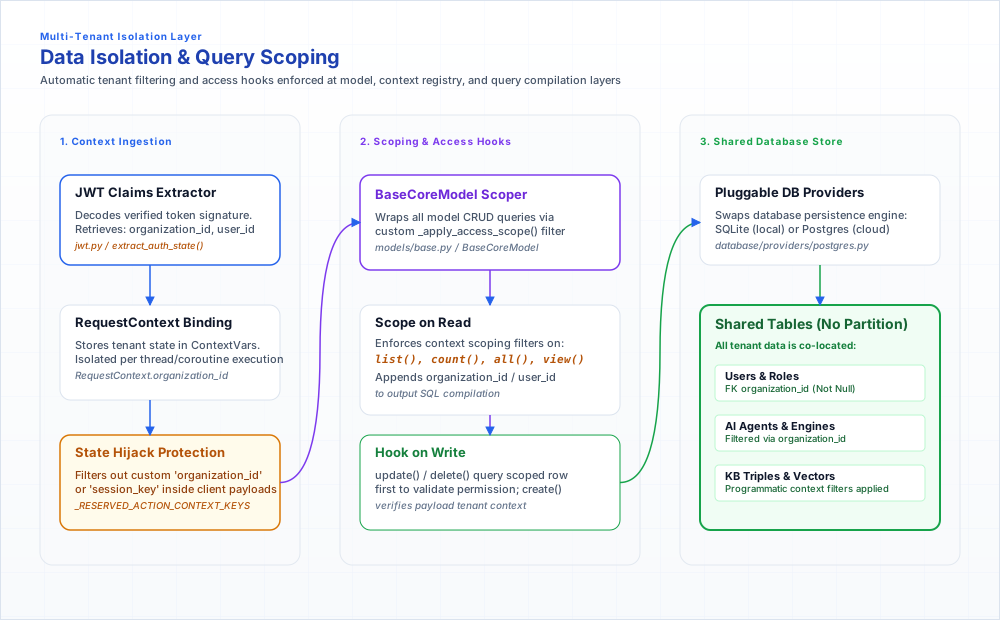
Actions and pages declare access requirements and run with the authenticated user and organization context.
Module models inherit base behavior that applies user and organization filters where configured.
Runtime policy
A Python-level Process Guard mediates extension behavior across platforms. OS-specific enforcement then applies the strongest available boundary for the host: Linux kernel controls, macOS Seatbelt, and Windows enforcement paths.
A default-on, portable layer that mediates which modules extension code may import and which network targets and files it may reach.
Landlock confines filesystem access, seccomp-BPF blocks escalation syscalls, and cgroup/iptables rules can enforce network egress when host privileges are available.
macOS uses Seatbelt profiles. Windows work uses low-integrity and WFP-based enforcement paths, with server-mode handling for hosted deployments.
External access is policy-gated in one place. Allowed targets can come from manifests, runtime approvals, or infrastructure configuration.
OS enforcement varies by host capability. When a host-specific kernel or platform layer cannot be applied, the SDK boundary, Process Guard, approval checks, and audit trail still define the runtime policy.
Practical security
The goal is not to promise invisible guarantees. The goal is to expose boundaries, checks, and audit evidence.
Extension code should depend on public SDK modules instead of core implementation paths.
Actions, tools, and engine calls can cross explicit policy gates, including external access approvals and token/request limits.
Policy failures should be visible as runtime errors and audit events rather than silent behavior.
Next
Use these pages to move from the concept to adjacent parts of the runtime.